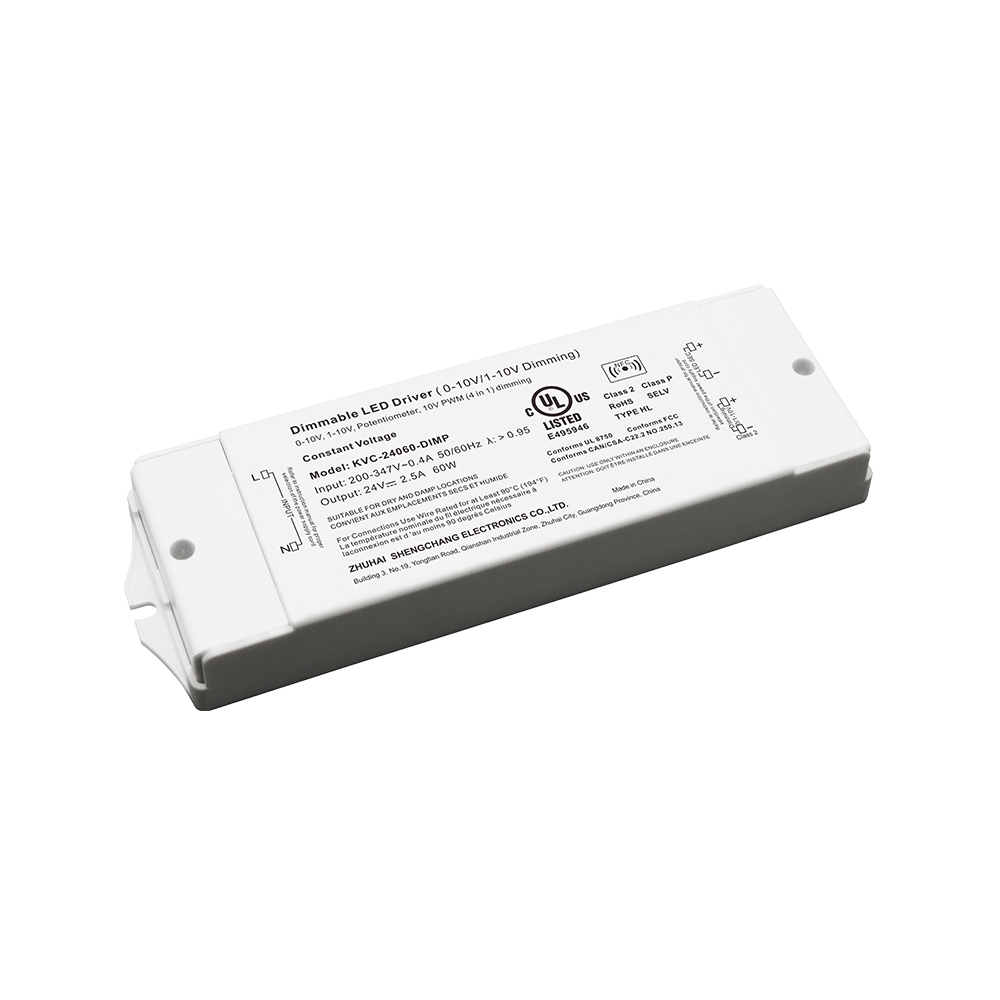
Commercial and industrial lighting projects in Canada often operate under higher-voltage electrical systems than those found in many other markets. In addition to common 120VAC and 277VAC applications, many commercial, institutional, industrial, and municipal facilities use 347VAC distribution systems to improve efficiency and simplify electrical infrastructure. This makes 200–347VAC LED drivers an increasingly practical choice for commercial lighting projects.
Compared with standard lighting applications, commercial environments require stable performance, long operating hours, and reliable control compatibility. An unsuitable LED driver may cause lower efficiency, dimming issues, unstable output, and higher maintenance costs.
The ideal 200–347VAC LED driver should provide wide input voltage compatibility, stable output, high efficiency, advanced dimming support, surge protection, and reliable thermal performance for long-term operation.
This guide explains how to evaluate commercial LED drivers and make better purchasing decisions for B2B lighting projects.
What Is a 200–347VAC LED Driver and Why Is It Used in Commercial Lighting
A 200–347VAC LED driver is a wide-input power conversion device designed to operate across North American commercial voltage systems while delivering stable constant-current or constant-voltage output to LED lighting systems.
Commercial facilities often use higher voltage infrastructure compared with residential environments. Instead of installing multiple transformers or dedicated circuits, wide input drivers simplify deployment and improve scalability.
A broad input LED driver enables the same lighting platform to operate across multiple project conditions without redesigning internal electrical architecture. This creates advantages for distributors and contractors managing projects across different electrical standards.
The LED driver performs several essential functions:
Converts AC input into regulated DC output
Maintains voltage stability
Controls current consistency
Supports 0–10V, DALI-2, D4i, DMX512, and non-dimming protocols
Protects against electrical fluctuations
Improves energy efficiency
Typical Commercial Applications
Application
Driver Requirement
Office Buildings
Stable output and dimming
Retail Spaces
High efficiency and flexibility
Healthcare Facilities
Long operating reliability
Industrial Buildings
Thermal stability
Educational Facilities
Energy optimization
Because one driver may support multiple luminaires across a large installation, reliability requirements are significantly higher than standard lighting applications.
How Commercial Power Distribution Influences Driver Selection
Commercial power architecture directly affects LED driver compatibility, installation cost, operational efficiency, and future scalability.
Commercial buildings are engineered differently from residential structures. Their electrical systems are optimized for larger loads and centralized power management.
Higher voltage environments reduce current demand and improve transmission efficiency. However, they also require stronger driver protection and more robust internal design.
Common Commercial Voltage Environments
Input Voltage
Typical Usage
120VAC
General indoor applications
208VAC
Small commercial facilities
240VAC
Mixed load systems
277VAC
Commercial lighting networks
347VAC
Large scale lighting distribution
Benefits of Broad Input Drivers
Reduce inventory complexity
Simplify project deployment
Improve installation flexibility
Lower maintenance requirements
Support future upgrades
Selecting wide input voltage capability improves procurement efficiency across multiple projects and regions.
Key Technical Specifications to Evaluate Before Purchasing
Commercial LED drivers should be evaluated through electrical performance, compatibility, environmental durability, and expected operating lifecycle.
Driver specifications directly determine system reliability. Procurement teams should compare technical performance rather than focusing only on wattage and purchase price.
Input Voltage Range
Input tolerance determines whether drivers can maintain stable operation under electrical fluctuations.
For Canadian commercial projects, buyers should verify whether the driver is certified for continuous operation across the full 200–347VAC range .
Certifications Required for Canada
Key certifications may include: UL Listed, cUL Listed, FCC Compliance, Class 2 Compliance (where applicable), RoHS Compliance .
Output Characteristics
Constant voltage output
Constant current output
Output regulation accuracy
Current ripple control
Efficiency Requirements
Metric
Recommended Target
Efficiency
Above 90%
Power Factor
Above 0.95
Thermal Stability
High
Output Consistency
Stable
Protection Functions
Over voltage protection
Over current protection
Short circuit protection
Over temperature protection
Load protection
High quality protection systems reduce downtime and lower total ownership costs.
How Efficiency and Power Factor Affect Operating Costs
Efficiency and power factor are two of the most important indicators for evaluating commercial LED driver performance because they directly influence electricity consumption, heat generation, system capacity, and long term operating costs.
Many buyers focus only on purchase price and rated wattage. However, long term operating expenses often exceed initial hardware costs.
Efficiency measures how effectively a driver converts electrical energy into usable output. Unused energy becomes heat and increases thermal stress.
Power factor measures how effectively electrical energy is utilized across the system.
Why Driver Efficiency Matters
Higher efficiency provides:
Lower electricity consumption
Reduced heat generation
Longer service life
Better lighting stability
Lower cooling requirements
Efficiency Comparison
Driver Efficiency
Energy Loss
Operating Impact
88%
Higher
Increased thermal load
92%
Moderate
Balanced performance
95%
Lower
Better operating economics
Understanding Power Factor
Power Factor
Commercial Recommendation
0.80
Basic operation
0.90
Acceptable
0.95+
Preferred
Efficient drivers with strong power factor performance support lower operating costs.
Selecting Dimming Compatibility for Commercial Projects
Dimming compatibility should be selected according to project scale, control requirements, user experience expectations, and future building automation plans.
Commercial lighting increasingly requires intelligent lighting control, energy management, occupancy sensing, and building automation integration.
Common Commercial Dimming Options
Dimming Method
Primary Advantage
Typical Scenario
0–10V
Simple integration
Commercial interiors
DALI
Addressable control
Large buildings
Wireless Control
Flexible deployment
Retrofit projects
Sensor Integration
Energy optimization
Smart facilities
Selection Factors
Number of fixtures
Control zones
Future automation plans
Installation complexity
Operational flexibility
Common Dimming Problems
Brightness instability
Visible flicker
Limited dimming range
Delayed response
Communication interruption
Compatibility testing before deployment reduces commissioning risks.
Environmental and Thermal Considerations for Long Term Reliability
Environmental conditions and thermal management directly impact LED driver lifespan, output consistency, and maintenance frequency.
Commercial environments often expose LED drivers to long operating cycles, elevated temperatures, voltage fluctuations, and challenging installation conditions.
Environmental Factors
Ambient temperature
Humidity
Air circulation
Dust exposure
Installation location
Operating duration
Installation Best Practices
Leave ventilation space
Avoid enclosed installations
Reduce peak loading
Separate wiring
Maintain thermal clearance
Temperature Impact
Operating Condition
Reliability
Controlled Temperature
Higher lifespan
Moderate Heat
Stable operation
Continuous High Temperature
Accelerated aging
Thermal management should be treated as a system level consideration.
Common Procurement Mistakes in Commercial LED Driver Selection
Most commercial LED driver failures are caused by specification mismatch and insufficient planning rather than manufacturing defects.
Common Purchasing Errors
Selecting only by wattage
Ignoring wide-input voltage capability (200–347VAC)
Overlooking dimming compatibility
Choosing insufficient reserve capacity
Neglecting environmental conditions
Procurement Checklist
Confirm voltage requirements
Verify output compatibility
Review efficiency targets
Validate dimming needs
Assess installation conditions
Evaluate maintenance strategy
System level purchasing delivers stronger lifecycle value.
How to Build a Sustainable LED Driver Purchasing Strategy
Long term procurement success depends on selecting LED drivers based on lifecycle performance instead of initial acquisition cost.
Organizations that standardize specifications and establish structured evaluation procedures often achieve stronger performance.
Recommended Procurement Framework
Define electrical architecture standards
Establish performance benchmarks
Create validation procedures
Standardize dimming compatibility
Monitor field reliability
Long Term Commercial Benefits
Procurement Focus
Business Outcome
Efficiency
Lower operating cost
Reliability
Reduced maintenance
Compatibility
Easier expansion
Thermal Stability
Longer service life
Selecting a Canada 200–347VAC LED driver is more than choosing a power component. It is a strategic decision that affects lighting quality, energy performance, operating economics, and project scalability.
By evaluating input flexibility, electrical performance, dimming capability, thermal management, and long term reliability together, commercial buyers can build lighting systems that deliver stable performance and sustainable value throughout their lifecycle.
Conclusion
Choosing the right Canada 200–347VAC LED driver requires balancing voltage compatibility, efficiency, dimming capability, certification requirements, and long-term reliability. It directly affects lighting performance, energy efficiency, maintenance costs, and long term project reliability.
For commercial lighting projects, buyers should prioritize wide input range, stable output, high efficiency, dimming compatibility, and thermal performance rather than focusing only on initial cost.
By evaluating electrical requirements, control needs, installation conditions, and lifecycle value together, businesses can build more reliable, scalable, and cost effective lighting systems.