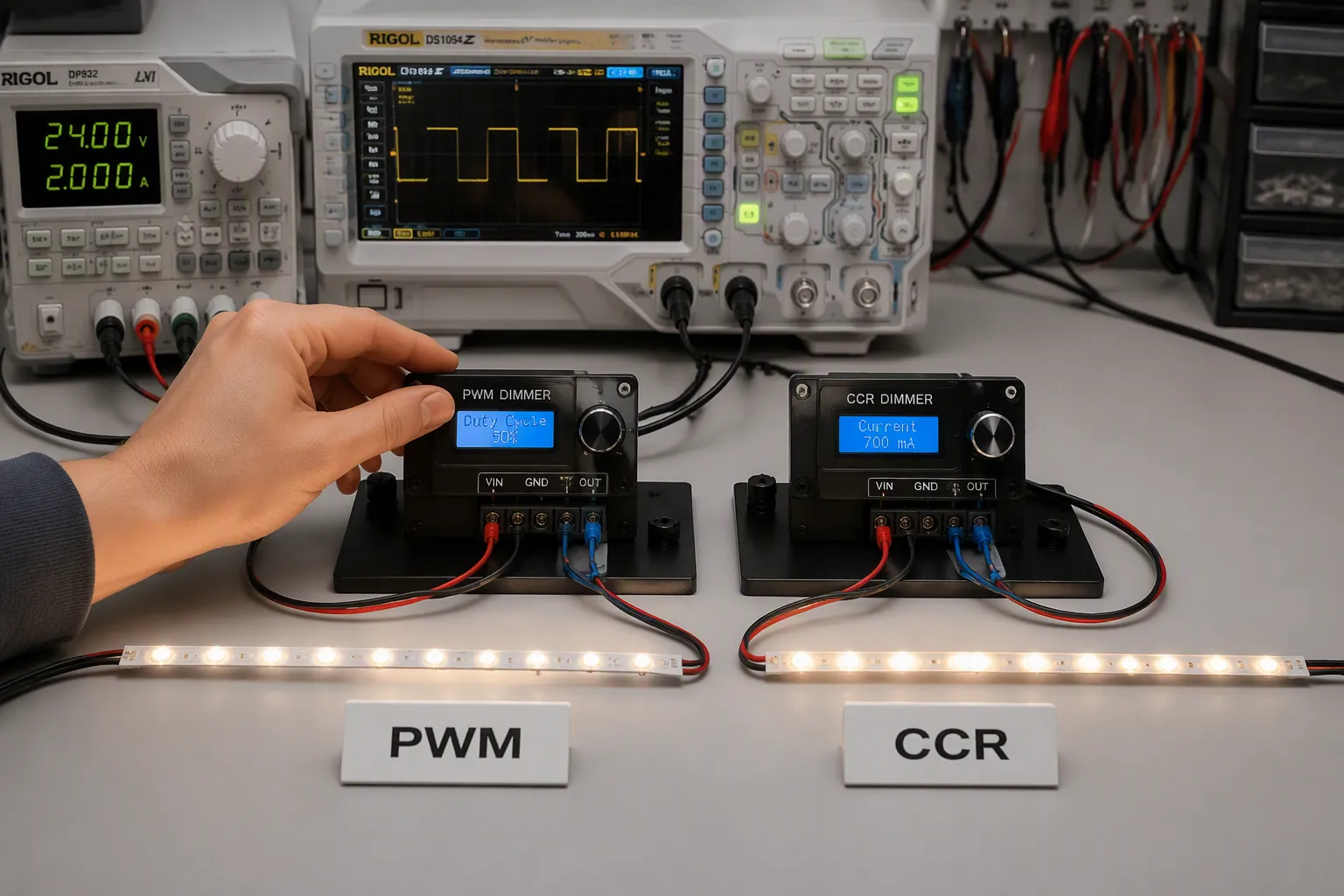
Neither PWM nor CCR dimming wins every case. The better method depends on your application. This comparison of pwm vs. ccr dimming covers flicker, efficiency, color stability, cost, and compatibility. You also get a practical decision guide at the end.
PWM switches the LED on and off at a high frequency, while CCR (Constant Current Reduction) continuously reduces the LED current. For a dimmable LED driver, the choice between PWM and CCR affects flicker performance, color stability, dimming depth, thermal behavior, and system compatibility.
Neither method is universally better. The right dimming approach depends on the LED load, required dimming range, control method, lighting environment, and application requirements. Some spaces need zero flicker for cameras and eyes. Others need deep dimming on a tight budget. Your answer sits in those details, not in a single winner.
Table of Contents
Toggle
Key Takeaways
PWM dimming turns LEDs on and off very fast, while CCR dimming reduces the flow of electricity in a smooth way.
PWM dimming can produce temporal light modulation, while CCR generally provides lower modulation from the dimming method itself. However, overall flicker performance depends on the complete LED driver design.
PWM dimming keeps color the same, but CCR dimming may make color warmer as you dim.
PWM drivers cost less and work with many controllers, but CCR drivers need more parts and heat control.
Pick CCR for places that are sensitive to flicker, like hospitals. Also pick it for tasks where color matters, like studios.
Use PWM for low-cost projects or when you need very low brightness below 10%.
Hybrid drivers combine both methods to cut flicker and boost dimming range.
Always check that your dimmer works with the LED driver to avoid flickering or buzzing with old TRIAC dimmers.
How PWM and CCR Dimming Work
PWM Dimming Basics
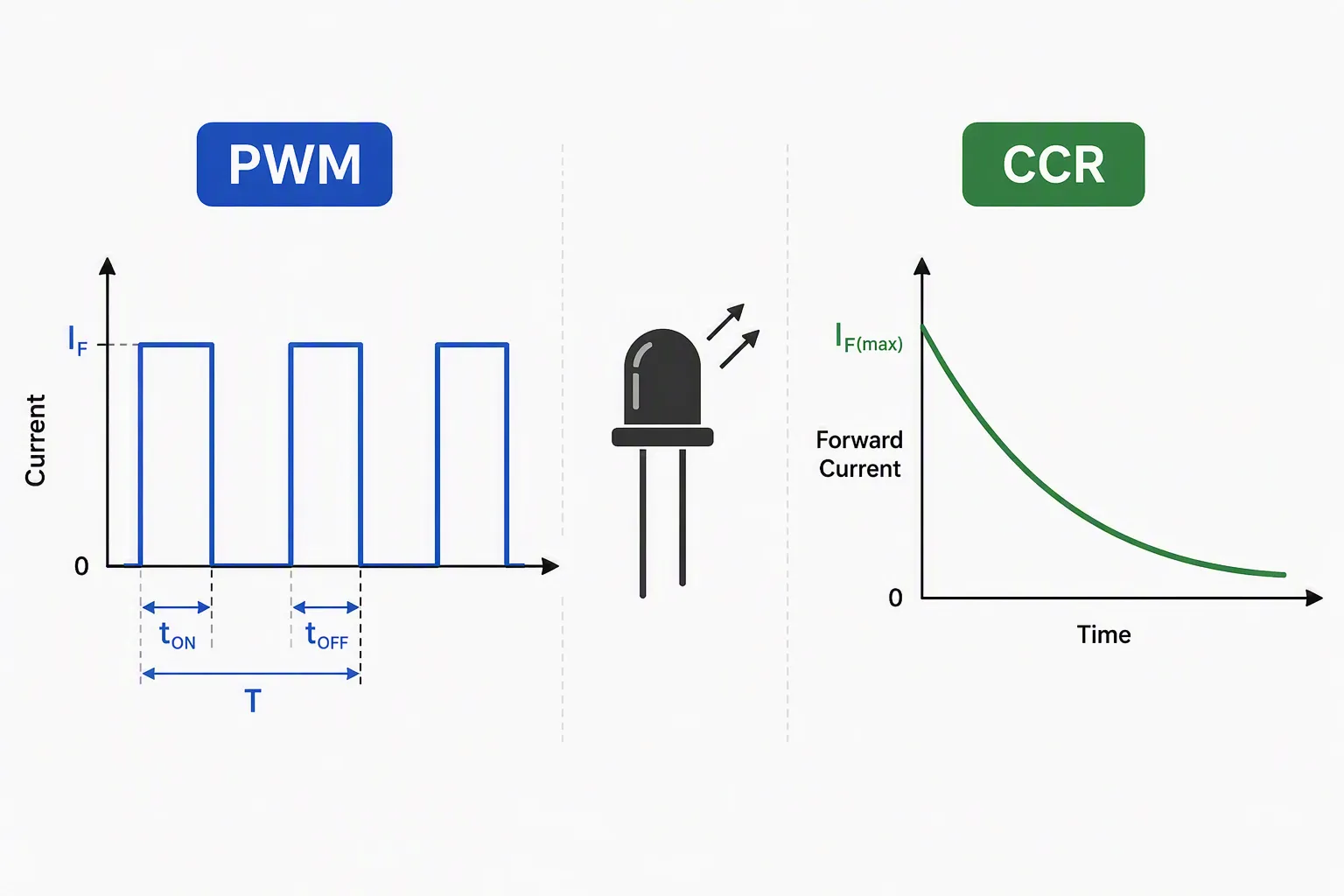
PWM dimming stands for pulse width modulation. It turns an LED on and off at a set frequency. The driver controls how long the LED stays on in each cycle. That on-time fraction is called the duty cycle. A 50% duty cycle means the LED is on for half of each cycle. Your eye blends this fast switching into a steady brightness level. The duty cycle sets that brightness level.
Duty Cycle Control
The link between duty cycle and perceived brightness is not linear. Human vision reacts to light in a nonlinear way. Low duty cycles already look quite bright. The table below shows this effect.
50% (half brightness, via gamma correction with γ = 2.2)
A straight sweep of duty cycle from 0% to 100% does not create a straight rise in perceived brightness. At 5% duty cycle, perceived brightness goes past 20% of maximum. At 20% duty cycle, it gets to almost 50% of maximum. Gamma correction fixes this mismatch. It uses the inverse of the perceived brightness curve. A common gamma value is 2.2. To get half brightness, the duty cycle is 0.5^2.2, which equals about 21.76%.
On/Off Switching
The LED in a PWM dimming circuit never sits at a partial current level. It runs at full current or zero current. This on/off action keeps the LED at its rated operating point during the on-time. The switching frequency stays high enough that you do not see the single pulses. You see only the average light output. This design makes PWM dimming easy to control with digital signals.
CCR Dimming Basics
CCR dimming, also called constant current reduction or analog dimming, takes a different path. The led driver holds the forward voltage steady and lowers the forward current instead. Luminous intensity depends on forward current, and this link is nearly linear. You dim the led by managing current, not by chopping the signal.
Linear Current Reduction
In continuous current reduction dimming, the driver steadily lowers the current sent to the led. The forward current changes with the dimming level in a smooth, steady way. No switching events happen. The light output follows the current down in a slow curve. This method is not recommended below 10% dimming. At very low currents, leds work poorly and show unpredictable light output. Lower drive currents can also cause color differences.
Amplitude Dimming
Amplitude dimming changes the height of the current waveform rather than its width. The led stays on the whole time. Its output amplitude shrinks as you dim. This steady operation fits applications that need a clean, steady light source. The led lighting stays constant in spectrum because the drive current stays above the unstable low-current region.
Core Operational Differences
Switching vs. Linear
PWM dimming uses switching regulation. The led driver turns the output on and off quickly. CCR uses linear regulation. The led driver steadily adjusts the current level. Switching makes a pulsed output. Linear regulation makes a steady output. This one difference drives most of the trade-offs between the two methods.
Driver Circuit Design
A dimmable led may support PWM or CCR, but not always both. PWM dimming drivers need a switching stage and a controller that sets the duty cycle. CCR drivers need a linear regulation stage that adjusts current without switching. The two circuit topologies differ in component count, heat profile, and control interface. Your choice of dimming method therefore shapes the whole led driver design, not just the control signal.
Flicker in PWM vs. CCR Dimming
PWM Dimming Flicker
Low-Frequency Visibility
PWM dimming turns your LED on and off many times each second. Pulse width modulation usually runs between 100 Hz and 400 Hz. Your eye may see this switching as flicker, especially at the edge of your vision. Frequencies below 80 Hz make light changes that people standing still can easily notice. The range from 15 to 20 Hz causes the flicker you notice most. Below 70 Hz, flicker makes it hard to read text and see fine details. One reader explained the problem clearly:
"I can tell you that lights strobing exacerbate my migraines. Even 120 hertz from fluorescent lights will affect me... LED lamps are no good... even the simplest ones strobe."
Above 2kHz Threshold
You might think a faster switching rate fixes everything. It does not. People can see flicker artifacts at 500 Hz. Flicker at frequencies up to 2,000 Hz can be seen during quick eye movements. The stroboscopic effect usually happens between 80 and 2,000 Hz. For some people, it goes up to 10,000 Hz. Researchers suggest frequencies above 3,000 Hz to avoid effects on the body. This threshold pushes most standard PWM drivers out of flicker safe dimming range.
CCR Flicker-Free Operation
No Switching Events
Constant current reduction dimming stops this problem at its source. The driver lowers the current supply instead of turning the light on and off. Your LED never switches quickly, so the output stays smooth over time rather than pulsed. No switching events means no flicker banding and no stroboscopic artifacts. This steady current flow gives CCR a clear win in flicker performance.
Video and Camera Use
Cameras show flicker that your eyes miss. A rolling shutter captures the light modulation pattern as bands across the frame. CCR removes this artifact because the light output never pulses. High-end flicker-free environments, such as medical and photography lighting, depend on this approach. Long-duration lighting exposure also helps, since visual strain drops when the source stays steady.
Flicker Sensitivity Factors
Human Perception Limits
Your sensitivity to flicker depends on several things. Light intensity matters: critical flicker frequency rises with brightness, from 22 to 25 Hz at low light levels up to 90 Hz at higher intensities. For showing moving images, the human flicker fusion threshold usually sits between 48 and 60 Hz. Even invisible flicker above your conscious perception threshold can cause bad health effects and stress responses.
Machine Vision Needs
Equipment sees differently than you do. Electroretinogram measurements give higher critical flicker frequency values than behavior-based studies, which shows unconscious perception above conscious thresholds. Birds reach much higher thresholds than humans. If your setup includes cameras, sensors, or automated inspection, treat flicker as a machine vision problem, not just a human comfort issue.
Efficiency of LED Driver Dimming Methods
PWM Efficiency at Low Dimming
Reduced On-Time Losses
PWM dimming keeps the LED at full current during each on-pulse. Conduction losses stay low because the LED driver spends less time delivering power as you dim. A 20% duty cycle means the LED conducts for only one-fifth of each cycle. Switching losses stay about the same, so total losses go down as brightness drops. This gives PWM dimming a clear efficiency win at low dimming levels. The pwm vs. ccr dimming comparison often starts here, because efficiency at low output is what separates the two methods.
Stable Current Operation
The LED in a PWM dimming circuit always runs at its rated current. This steady current keeps the LED working in its most efficient range. You avoid the poor efficiency that comes from running an LED at very low currents. PWM dimming drivers therefore give strong performance across a wide dimming range. This dimming method also avoids the color shift that can show up when current drops too low.
CCR Efficiency at Low Dimming
Increased Driver Losses
CCR dimming lowers the current through the LED. The LED driver has to drop the extra voltage across its linear regulation stage. That wasted voltage turns into heat. As you dim deeper, the voltage drop across the driver gets bigger. Driver losses go up sharply at low dimming levels. This makes CCR dimming less efficient than PWM dimming in deep dimming applications. The flicker performance of CCR stays excellent, but efficiency takes a hit.
Heat Generation
The heat from linear regulation creates a real design problem. You need bigger heatsinks and more thermal management. This heat also affects the LED itself. Higher temperatures shorten LED lifetime and can shift color output. CCR dimming therefore needs careful thermal design, especially in enclosed fixtures. Many led lighting designs stay away from CCR for this reason.
Practical Crossover Points
When PWM Loses Edge
PWM dimming loses its efficiency edge at very low duty cycles. Switching losses become a bigger share of total losses. The driver still switches at full voltage, so each switching event wastes energy. At very low duty cycles, PWM dimming efficiency drops in a way you can notice. Electromagnetic interference also grows at higher switching frequencies. Flicker can also become visible at these low duty cycles.
When CCR Loses Edge
CCR dimming loses its edge whenever the voltage difference between the supply and the LED is large. That difference becomes wasted heat. CCR also struggles below 10% dimming, where LED performance becomes unpredictable. For deep dimming with high efficiency, PWM dimming remains the better choice. Two drivers may look the same, yet their dimming behavior differs a lot.
Color Consistency and Light Quality
PWM and Color Shift
Spectral Stability On-Time
PWM dimming keeps the LED at its full current during every on-pulse. The semiconductor junction stays at a steady temperature and carrier density. This stable operating point keeps the emission spectrum the same across the full dimming range. Your white point stays where you set it, even as you lower the led brightness.
Low Duty Cycle Effects
The table below shows how each dimming method affects color as you dim from full output to 1%.
PWM dimming holds CCT within ±50K and keeps CRI within 2 points of full output at 10% dimming. The led stays color-stable because the chip never leaves its rated operating point.
CCR and Color Stability
Consistent Spectrum
CCR dimming lowers the continuous forward current instead. At 10% dimming, the led gets 10% of rated current. LED chromaticity does not follow current in a straight line. The blue pump wavelength shifts 2–4 nm, phosphor conversion efficiency changes, and the white point drifts warmer. This is physics, not a design flaw.
High-CRI Suitability
CCR dimming shifts CCT by 200–600K warmer and drops CRI by 5–15 points at 10% dimming. That drift makes CCR a poor fit for high-CRI work. A fixture rated at CRI 95 at full output may fall well below that mark as you dim. For color-critical tasks, this loss of led performance matters more than any efficiency gain.
Color-Critical Applications
Studio and Photography
Studios need a stable color temperature at every brightness level. PWM dimming delivers that stability. A photographer can dim from full power to a faint fill light without a white balance shift. CCR dimming would push the color warmer as the light dims, forcing a new white balance at every level.
Medical and Retail
Medical lighting and retail displays also depend on color accuracy. A surgeon needs tissue to look the same at every brightness setting. A retailer needs a red dress to stay red under dimmed light. PWM dimming protects both cases. CCR dimming introduces a warm drift that can misrepresent skin tones, fabric colors, and product labels. When color fidelity drives your choice, PWM dimming is the safer dimming method.
Cost and Compatibility of LED Drivers
PWM Driver Cost
Simple Circuit Design
A PWM dimming driver costs less to make than a CCR driver. The circuit uses a switching stage and a simple controller. You do not need big heatsinks or complex thermal management. This keeps the bill of materials low. A PWM dimming driver also runs cooler, so you save on enclosure costs. For LED lighting projects on a budget, PWM dimming is the practical choice.
Controller Compatibility
PWM dimming drivers work with many different controllers. You can run them with digital signals, microcontrollers, or standard dimmer modules. This flexibility makes PWM dimming easy to add to new designs. Most PWM dimming drivers accept a 0-10V signal, a PWM input, or a digital addressable protocol. You get more options without custom engineering.
CCR Driver Cost
Linear Regulation Complexity
A CCR LED driver needs a linear regulation stage. This stage drops extra voltage as heat. The design must handle that heat with bigger heatsinks and careful layout. The control loop for steady current also adds complexity. These factors push the cost of a CCR LED driver above a similar PWM dimming driver.
Component Count
CCR drivers use more parts than PWM dimming drivers. You need pass transistors, current-sense resistors, and thermal protection circuits. Each part adds cost and takes up board space. A PWM dimming driver avoids most of these parts. The higher component count also lowers reliability and raises assembly time.
System Integration
Existing Dimmer Support
You will run into compatibility problems when you pair either dimming method with old phase-cut dimmers. Leading-edge TRIAC dimmers often cause trouble for both PWM and CCR LED drivers. You may see flickering when the dimmer cannot handle the load. Buzzing or humming happens when an older TRIAC dimmer clashes with the LED driver. The dimming range may also shrink because the driver's lower threshold does not match the dimmer output. Some setups drop out at higher brightness levels. Uneven brightness across multiple fixtures points to mismatched driver specs or minimum load issues. These problems show up with both PWM dimming and CCR dimming, so check dimmer compatibility before you buy.
Retrofitting Considerations
Retrofitting an existing system with PWM dimming drivers is usually easier. You can often keep the existing wiring and replace only the driver. CCR drivers may need a new dimmer and a larger thermal path. Always check the dimmer type and the minimum load. A compatible dimmer and a matched LED driver will give you smooth, reliable dimming.
Decision Guide for Dimming Methods
You now have the full picture of pwm vs. ccr dimming. The next step is matching the method to your project. This guide walks you through the key decision points.
Revised Decision Guide
How to Choose Between PWM and CCR Dimming
The right dimming method depends on the complete LED driver and lighting system rather than on PWM or CCR alone.
Consider PWM When
PWM may be suitable when the application requires a wide dimming range, precise digital control, or stable LED operating current during the on-time. For professional lighting, select a driver with an appropriate PWM frequency and verified flicker performance.
Consider CCR When
CCR may be suitable when very low temporal light modulation is a priority and the required dimming range can be achieved without unacceptable color shift or thermal loss. The LED and driver should be evaluated together across the intended operating range.
Consider Hybrid Dimming
Hybrid PWM + CCR designs can combine continuous current reduction at higher output levels with PWM control at lower output levels. This approach can help balance flicker performance, color consistency, efficiency, and dimming depth, depending on the driver architecture.
For a dimmable LED driver, also consider the control interface, LED load type, CV or CC output, minimum load, dimming range, thermal conditions, and required certifications before selecting the driver.
When to Choose PWM
Cost-Sensitive Projects
PWM dimming drivers cost less to build and install. The circuit uses fewer parts and needs no large heatsinks. You save on the bill of materials and on enclosure costs. PWM dimming drivers also work with many controllers, like 0-10V signals, microcontrollers, and digital protocols. For budget-driven led lighting projects, pwm dimming is the practical pick.
Wide-Range Dimming
PWM dimming keeps its efficiency edge at low output levels. The led runs at full current during each on-pulse, so conduction losses drop as you dim. This gives you a wide usable dimming range. CCR struggles below 10% dimming, where led performance becomes unpredictable. If you need deep dimming with stable efficiency, pwm dimming drivers give better results.
Hybrid and Adaptive Approaches
Combined PWM and CCR
New led driver designs mix both methods into one system. CCR handles the high-brightness region, where it naturally avoids flicker. PWM takes over at low brightness levels to extend the usable dimming range. This hybrid approach carries forward some limits from both methods. It does not fully solve flicker and consistency issues, especially when perceived brightness matters more than measured light output. Still, the design combines the strengths of each method for smoother overall performance.
One example comes from Meteor. Their proprietary driver platform combines optimized CCR and precise PWM control to reduce invisible led flicker. It gives stable dimming for high-speed video capture up to 960 fps. Ottima Tech describes a similar strategy: analog current reduction in the high-brightness region and high-frequency PWM in the low-brightness region. This keeps dimming precision and color consistency across the full range.
Emerging Driver Systems
Commercial driver ICs now implement hybrid schemes in silicon. The Dior Inc. AL5887Q is a 36-channel, automotive-grade led driver. It combines hybrid PWM and analog (CCR) dimming. PWM dimming covers 100% down to 3% duty cycle. Below 3%, the chip switches to programmable digital control that achieves CCR-equivalent dimming. This is not a traditional analog CCR circuit, but it delivers the same effect. Such chips show where the market is heading: adaptive systems that pick the best dimming method for each brightness level.
Your choice still matters. For flicker-sensitive or color-critical work, choose CCR. For cost-sensitive projects or wide-range dimming, choose PWM. For everything in between, hybrid drivers offer a middle path. Evaluate your application requirements first. The right dimming method follows from your needs, not from a default preference.
PWM wins on efficiency and wide dimming range. CCR wins on flicker-free, color-stable output.
Choose CCR for flicker-sensitive or color-critical tasks. Choose PWM for cost-sensitive projects or deep dimming. Test your own requirements first.
Hybrid drivers blend PWM and CCR. They switch methods as brightness changes. This cuts flicker and extends dimming range. PWM handles low output; CCR handles high output. Together they reduce flicker risk. PWM flicker at low duty cycles and CCR flicker at high currents both matter. PWM flicker comes from switching; CCR flicker stays absent. PWM still wins on cost. PWM flicker and CCR flicker differ. PWM flicker needs care and PWM testing. CCR flicker stays low. Driver technology keeps evolving.
FAQ
Which dimming method causes flicker?
PWM dimming causes flicker because the driver turns the LED on and off. Frequencies between 80 Hz and 2,000 Hz create visible stroboscopic effects. CCR dimming has no switching events, so the light output stays steady. For spaces that are sensitive to flicker, CCR is the safer choice.
Can I use PWM dimming for video recording?
You can, but you need a high switching frequency. Standard pwm drivers run between 100 Hz and 400 Hz, which cameras pick up as banding. Frequencies above 3,000 Hz cut down these artifacts. CCR dimming avoids the problem completely because the current never pulses.
Does CCR dimming change the color of my LED light?
Yes. CCR dimming shifts the color temperature 200–600K warmer at 10% dimming. CRI also drops 5–15 points. PWM dimming holds CCT within ±50K and keeps CRI stable. For color-critical work, pwm dimming protects your white point across the dimming range.
Which method is cheaper for LED drivers?
PWM drivers cost less. The circuit uses fewer parts and needs no large heatsinks. CCR drivers require linear regulation, pass transistors, and thermal protection circuits. Those parts add cost and board space. For budget-driven projects, pwm dimming is the practical pick.
How deep can I dim with each method?
PWM dimming works well across a wide range, even below 1% duty cycle. CCR dimming struggles below 10% dimming, where LED performance becomes unpredictable. If you need deep dimming with stable efficiency, pwm drivers give better results.
What is hybrid dimming?
Hybrid drivers mix both methods together. CCR handles high brightness, where it avoids flicker. PWM takes over at low brightness to extend the dimming range. This approach lowers flicker risk and improves color consistency. Commercial driver ICs now build hybrid schemes in silicon.
Do old TRIAC dimmers work with these drivers?
Both methods can have trouble with leading-edge TRIAC dimmers. You may see flickering, buzzing, or a reduced dimming range. Check dimmer compatibility before you buy. A matched dimmer and driver give smooth, reliable dimming.
Which method suits medical lighting?
CCR suits medical spaces because it produces no flicker. Hospitals need steady light for patient comfort and staff focus. DALI and 0-10V systems deliver flicker-free control. PWM dimming can cause eye strain in these environments.